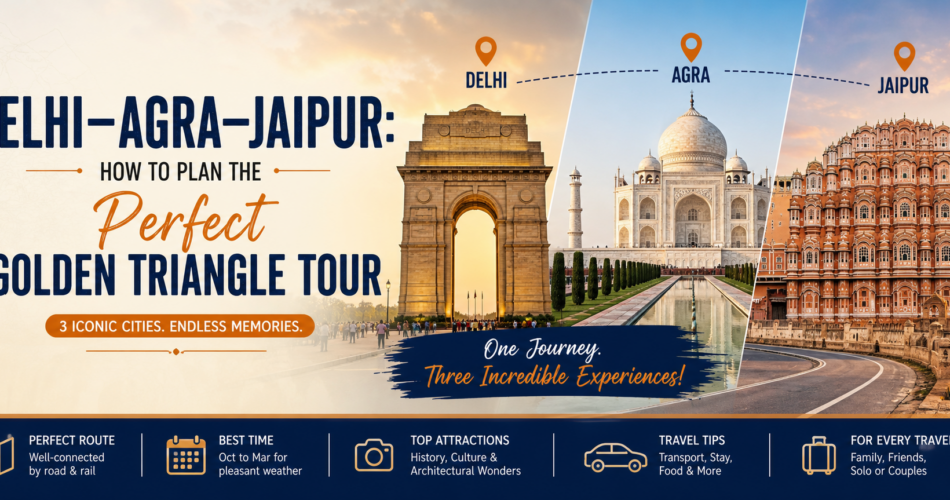
The Delhi–Agra–Jaipur Golden Triangle Tour is one of the most popular ways to experience India’s historic architecture, royal heritage, vibrant culture and diverse traditions in one memorable journey. Connecting India’s capital Delhi with the Mughal city of Agra and Rajasthan’s famous Pink City Jaipur, this route brings together three destinations with distinct identities.
A well-planned Golden Triangle tour can include magnificent forts, historic monuments, grand palaces, colorful markets, traditional cuisine and unforgettable cultural experiences. Whether you are travelling with family, friends or as a couple, planning the route carefully can make the journey more comfortable and enjoyable.
In this guide, we explain Delhi–Agra–Jaipur: How to Plan the Perfect Golden Triangle Tour, including suggested itineraries, transportation options, important attractions and practical travel tips.
What Is the Golden Triangle Tour?
The Golden Triangle generally connects Delhi, Agra and Jaipur. These three cities form a popular tourist circuit because of their concentration of historic landmarks, cultural attractions and architectural heritage.
Agra is officially recognized as part of the Golden Triangle tourist circuit along with Delhi and Jaipur. The city is particularly known for the Taj Mahal, Agra Fort and Fatehpur Sikri.
A typical route is:
Delhi → Agra → Jaipur
This route works well because you can travel progressively from Delhi to Agra and then continue towards Jaipur rather than repeatedly returning to the starting point.
How Many Days Are Needed for a Golden Triangle Tour?
The ideal duration depends on how much sightseeing you want to include.
A short trip can cover the three cities in around four days, while a more relaxed itinerary can take five to seven days.
Suggested Durations
| Duration | Suggested Plan |
| 3 Days | Delhi + Agra + Jaipur highlights |
| 4 Days | Delhi + Agra + Jaipur with major attractions |
| 5 Days | More relaxed sightseeing |
| 6–7 Days | Detailed sightseeing and additional experiences |
ASTT currently offers Golden Triangle packages ranging from shorter itineraries to longer 7-day programs. Its published 4-day/3-night option covers one night in Delhi, one in Agra and one in Jaipur, while its longer car-based itinerary covers seven days and six nights.
Day 1: Explore Delhi’s Heritage
Start your Golden Triangle journey in Delhi, India’s capital and a city where historic monuments exist alongside a modern urban environment.
Delhi Tourism highlights attractions including the Red Fort, Qutub Minar, Humayun’s Tomb, India Gate, Lotus Temple and other heritage and cultural destinations.
Recommended Delhi Attractions
Depending on your arrival time, consider visiting:
- Qutub Minar
- Humayun’s Tomb
- India Gate
- Lotus Temple
- Red Fort
- Jama Masjid
- Chandni Chowk
- Raj Ghat
Trying to visit every attraction in a single day can make the schedule tiring, so choose locations according to your interests.
Evening in Delhi
After sightseeing, enjoy a local meal and explore a suitable market or shopping area before resting for the night.
If you are travelling with family, keeping the first evening relaxed can help everyone prepare for the next day’s journey.
Day 2: Delhi to Agra
Start your second day with a journey from Delhi to Agra.
Delhi Tourism’s Golden Triangle itinerary also follows the Delhi–Agra–Jaipur route, highlighting Agra’s Mughal heritage and Jaipur’s royal attractions.
Depending on traffic, departure point and travel conditions, the road journey can take several hours, so an early start is useful.
Arrive in Agra
After reaching Agra, check into your hotel or proceed directly to sightseeing depending on your travel arrangements.
Agra’s most famous attractions include:
Taj Mahal
The Taj Mahal is the centerpiece of most Agra itineraries. Its white-marble architecture and Mughal history make it one of India’s most recognizable landmarks.
Allow sufficient time for entry, sightseeing and photography rather than trying to rush through the complex.
Agra Fort
Agra Fort provides another major connection to Mughal history. The vast red-sandstone complex contains historic palaces, courtyards and halls.
Mehtab Bagh
If time permits, Mehtab Bagh can be added to your Agra itinerary for a different view of the Taj Mahal from across the Yamuna.
Evening in Agra
After sightseeing, enjoy dinner and rest at your hotel.
You can also explore local handicrafts and traditional products if time allows.
Day 3: Agra to Jaipur via Fatehpur Sikri
Day three connects Agra with Jaipur and can include an important heritage stop along the way.
Visit Fatehpur Sikri
Fatehpur Sikri is a historic Mughal city associated with Emperor Akbar. Its red sandstone architecture and monumental structures make it a popular addition to the Agra–Jaipur route.
Delhi Tourism also includes Fatehpur Sikri as an important attraction in its Golden Triangle itinerary.
Optional Stop: Chand Baori
Travellers with additional time can consider a stop at Chand Baori near Abhaneri, known for its dramatic stepwell architecture.
ASTT currently offers an Agra-to-Jaipur route that includes Fatehpur Sikri and Chand Baori, with private transportation and Jaipur drop-off options.
After sightseeing, continue towards Jaipur and check into your hotel.
Day 4: Discover Jaipur’s Royal Heritage
Jaipur, popularly known as the Pink City, is the final major destination of the Golden Triangle.
The city combines royal architecture, historic observatories, colorful markets and traditional Rajasthani culture.
Amber Fort
Begin your Jaipur sightseeing with Amber Fort.
The fort complex contains palaces, courtyards, gardens and architectural details reflecting Jaipur’s royal history.
City Palace
Continue to City Palace to explore the historic royal complex and its collections.
Jantar Mantar
Jantar Mantar is another important Jaipur attraction. It contains large astronomical instruments associated with the scientific traditions of the historic city.
Hawa Mahal
No Jaipur itinerary is complete without seeing Hawa Mahal, one of the city’s most recognizable architectural landmarks.
You can combine it with a visit to nearby markets and other central Jaipur attractions.
Jal Mahal
If your schedule allows, include a photo stop at Jal Mahal, the palace located in the middle of Man Sagar Lake.
Golden Triangle Tour Itinerary at a Glance
| Day | Route | Main Experiences |
| Day 1 | Delhi | Qutub Minar, Humayun’s Tomb, India Gate, Red Fort |
| Day 2 | Delhi → Agra | Taj Mahal, Agra Fort, Mehtab Bagh |
| Day 3 | Agra → Jaipur | Fatehpur Sikri, optional Chand Baori |
| Day 4 | Jaipur | Amber Fort, City Palace, Jantar Mantar, Hawa Mahal |
This is a sample itinerary and can be adjusted according to arrival times, hotel locations and sightseeing preferences.
Best Way to Travel the Golden Triangle
There are several ways to organize transportation between Delhi, Agra and Jaipur.
Private Car
A private car can provide flexibility because you can arrange sightseeing, stops and hotel transfers around your schedule.
This can be particularly convenient for families and groups carrying luggage.
Train
Trains can also connect major cities on the Golden Triangle route. They can be useful when you prefer rail travel, although you will still need local transportation for sightseeing.
Combination of Train and Car
Another option is to use trains between selected cities and arrange private transportation for local sightseeing.
The best option depends on your schedule, group size, budget and preferred travel style.
Why a Private Golden Triangle Tour Can Be Convenient
A private tour can make a multi-city itinerary easier to manage because transportation, sightseeing and transfers can be coordinated in advance.
ASTT’s current Golden Triangle car itinerary includes Delhi, Agra and Jaipur, with transportation by car and options for guide services. Its published itineraries include hotel transfers and sightseeing at major attractions across the three cities.
For travellers who want a more relaxed experience, having transportation arranged in advance can reduce the need to coordinate separate taxis in every city.
Golden Triangle Travel Tips
1. Start Early
Early departures help create more sightseeing time and can make intercity travel more manageable.
2. Avoid Overpacking the Schedule
The Golden Triangle includes three major cities with many attractions. Trying to visit everything can make the trip exhausting.
Select the attractions that matter most to you.
3. Keep Travel Time in Mind
Delhi, Agra and Jaipur are connected by road and rail, but travel time should always be included when planning each day.
4. Reserve Accommodation in Advance
Choose hotels according to your sightseeing plans and transportation arrangements.
Staying in convenient locations can reduce unnecessary travel within each city.
5. Carry Comfortable Clothing and Footwear
Golden Triangle sightseeing involves considerable walking, especially around forts, monuments and historical complexes.
6. Keep Some Flexible Time
Leave space for meals, shopping, photography and unexpected traffic delays.
7. Check Monument Rules Before Visiting
Opening hours, ticket prices, entry rules and visitor regulations can change. Check official information before visiting major monuments.
Golden Triangle Tour for Families
Families can make the itinerary more comfortable by avoiding an overly packed schedule.
A family-friendly plan can include:
- Comfortable private transportation
- Regular meal breaks
- Flexible sightseeing
- Family-friendly hotels
- Shorter sightseeing sessions
- Extra travel time for children and older family members
A private car can also make it easier to manage luggage and move directly between hotels and attractions.
Golden Triangle Tour for Couples
Couples may prefer a slower itinerary with time for photography, local food and evening experiences.
Instead of rushing through every attraction, consider selecting a few important places in each city and leaving time to enjoy the destination.
Agra can be particularly memorable for couples because of the Taj Mahal, while Jaipur offers historic palaces, forts and colorful markets.
What to Pack for a Golden Triangle Tour
A practical packing list includes:
- Comfortable walking shoes
- Light and comfortable clothing
- Sunglasses
- Water bottle
- Phone and charger
- Power bank
- Basic personal essentials
- Travel documents
- Small day bag
Pack according to the season because temperatures across Delhi, Agra and Jaipur can vary considerably.
Plan Your Golden Triangle Tour with ASTT
ASTT (Agra Shiv Tour And Travels™) provides Golden Triangle tour packages connecting Delhi, Agra and Jaipur.
ASTT currently lists several Golden Triangle itineraries, including a 3-night/4-day package and a 6-night/7-day car-based tour. Its published services include private car transportation, driver services, guide options and sightseeing across Delhi, Agra and Jaipur.
Depending on the selected itinerary, travellers can visit attractions such as:
- Red Fort
- Qutub Minar
- India Gate
- Taj Mahal
- Agra Fort
- Mehtab Bagh
- Fatehpur Sikri
- Amber Fort
- City Palace
- Hawa Mahal
- Jantar Mantar
ASTT also offers routes between Agra and Jaipur via Fatehpur Sikri and Chand Baori, making it possible to add additional heritage experiences to your journey.
For tour enquiries and bookings, contact ASTT at +91-9759000249.
Frequently Asked Questions
How many days are ideal for a Delhi–Agra–Jaipur Golden Triangle Tour?
Four to seven days can provide different levels of sightseeing flexibility. A shorter trip can cover the major highlights, while a longer itinerary allows more relaxed exploration.
What is the usual Golden Triangle route?
A common route is Delhi → Agra → Jaipur, although the itinerary can be arranged in another order depending on your arrival and departure locations.
Which places should I visit in Agra?
The Taj Mahal and Agra Fort are the major highlights. Depending on your available time, you can also include Mehtab Bagh, Itmad-ud-Daulah and Fatehpur Sikri.
Can I visit Fatehpur Sikri between Agra and Jaipur?
Yes. Fatehpur Sikri is a practical heritage stop to consider when travelling from Agra towards Jaipur.
Is a private car suitable for a Golden Triangle Tour?
A private car can be convenient when you want flexible sightseeing, direct hotel transfers and the ability to add stops along the route.
Can ASTT customize a Golden Triangle itinerary?
ASTT publishes multiple Golden Triangle itineraries of different durations and also offers car-based tours connecting Delhi, Agra and Jaipur. Contact ASTT directly to discuss the itinerary, vehicle and sightseeing requirements for your trip.
Final Thoughts
A well-planned Delhi–Agra–Jaipur Golden Triangle Tour combines three different sides of India’s heritage in one journey.
Delhi introduces travellers to India’s capital and its historic landmarks. Agra brings the grandeur of Mughal architecture, including the Taj Mahal and Agra Fort. Jaipur completes the journey with royal forts, palaces, observatories and vibrant Rajasthani culture.
The key to planning a comfortable Golden Triangle trip is to balance sightseeing with travel time, choose practical transportation and leave enough flexibility in your schedule.
For private transportation, customized sightseeing and Golden Triangle tour arrangements, contact ASTT (Agra Shiv Tour And Travels™) at +91-9759000249.