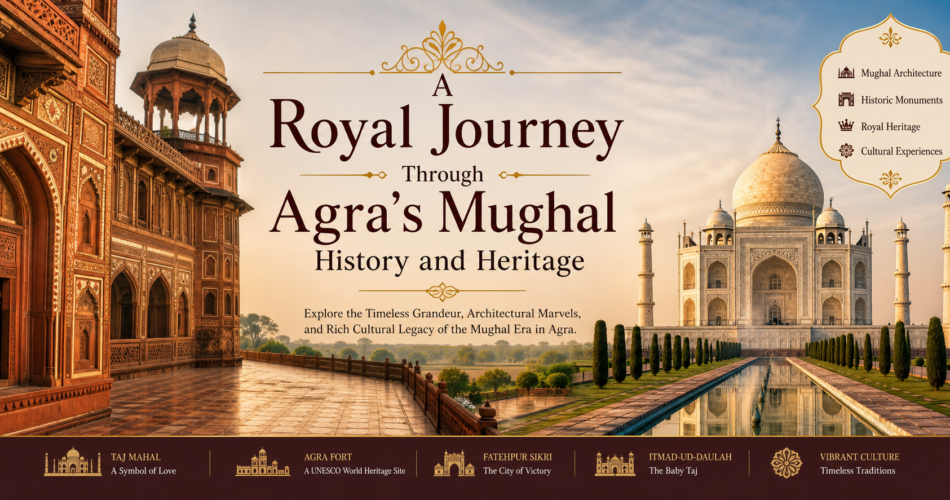
Agra is a city where history, architecture and culture come together along the banks of the Yamuna River. While the Taj Mahal is its most famous landmark, Agra’s heritage extends far beyond this iconic monument. The city was an important Mughal centre under emperors including Akbar, Jahangir and Shah Jahan, leaving behind magnificent forts, tombs, gardens and architectural masterpieces.
A journey through Agra’s Mughal heritage offers an opportunity to discover the stories behind these monuments and understand how the city developed into one of India’s most important historical destinations.
This guide, A Royal Journey Through Agra’s Mughal History and Heritage, takes you through the city’s most significant Mughal landmarks and explains how to plan a memorable heritage tour.
Agra and the Mughal Empire
Agra’s Mughal history became particularly significant after Babur’s victory at the First Battle of Panipat in 1526. Under Akbar, Jahangir and Shah Jahan, Agra became one of the principal centres of the Mughal Empire and was known as Akbarabad. (agra.nic.in )
Akbar developed Agra as an important administrative, cultural and architectural centre. He rebuilt the great fort in red sandstone and later established Fatehpur Sikri nearby.
Jahangir continued the city’s development, while Shah Jahan became especially famous for his interest in architecture. His reign produced the Taj Mahal, one of the world’s most celebrated examples of Mughal architecture. (agra.nic.in )
Today, these monuments provide a remarkable architectural record of Agra’s Mughal past.
1. Taj Mahal: The Symbol of Mughal Architecture
The Taj Mahal is the centerpiece of any Agra Mughal heritage tour.
Commissioned by Emperor Shah Jahan in memory of Mumtaz Mahal, the ivory-white marble mausoleum stands on the southern bank of the Yamuna. The monument was completed over approximately 17 years and forms part of a larger complex containing the mausoleum, mosque, guest house and formal charbagh gardens. (agra.nic.in )
What Makes the Taj Mahal Special?
Visitors can admire:
- White marble architecture
- Intricate inlay work
- Calligraphic decoration
- Symmetrical gardens
- Reflecting pools
- The mosque and guest house
- Views toward the Yamuna
The Taj Mahal is a UNESCO World Heritage Site and remains one of the most recognizable monuments associated with Mughal India. (agra.nic.in )
For visitors planning a sunrise experience, the monument’s current visitor hours begin 30 minutes before sunrise and continue until 30 minutes before sunset. Regular visitor access is closed on Fridays. Always check the official information before travelling because rules and fees can change. (agra.nic.in )
2. Agra Fort: The Mughal Imperial City
After visiting the Taj Mahal, continue to Agra Fort, another UNESCO World Heritage Site.
Agra Fort was rebuilt in red sandstone by Emperor Akbar from 1565 and was subsequently developed by later Mughal rulers. Its massive walls enclose palaces, audience halls and other important structures. (agra.nic.in )
Important Structures Inside Agra Fort
- Jahangir Mahal
- Khas Mahal
- Diwan-i-Aam
- Diwan-i-Khas
- Sheesh Mahal
- Musamman Burj
- Moti Masjid
The fort is approximately 2.5 km from the Taj Mahal, making it easy to combine both monuments in the same sightseeing itinerary. (agra.nic.in )
Musamman Burj is particularly significant because Shah Jahan spent his final years there, and the location provides views toward the Taj Mahal. (agra.nic.in )
3. Itmad-ud-Daulah: The Elegant ‘Baby Taj’
For travellers interested in the evolution of Mughal architecture, the Tomb of Itmad-ud-Daulah is an important stop.
Built between 1622 and 1628 by Empress Nur Jahan for her father Mirza Ghiyas Beg, the monument is regarded by the District Agra administration as the first Mughal structure built entirely from white marble and an early major example of extensive pietra dura inlay. This is why it is popularly known as the Baby Taj. (agra.nic.in )
Highlights
- Delicate marble screens
- Pietra dura decoration
- Symmetrical gardens
- Detailed floral patterns
- Riverside setting
The monument is also relatively peaceful compared with Agra’s busiest attractions, making it a good place to slow down and appreciate Mughal craftsmanship.
4. Mehtab Bagh: A Mughal Garden by the Yamuna
Mughal heritage was not limited to forts and tombs. Gardens were an important part of Mughal landscape design.
Mehtab Bagh, located across the Yamuna from the Taj Mahal, provides a different perspective of the famous monument. The historic garden was originally laid out by Babur and later aligned with the Taj Mahal’s design during Shah Jahan’s period. (agra.nic.in )
The garden is particularly interesting for travellers who enjoy:
- Heritage gardens
- Taj Mahal photography
- Riverside landscapes
- Quiet sightseeing
- Mughal garden design
5. Akbar’s Tomb at Sikandra
Another important part of Agra’s Mughal heritage is Akbar’s Tomb at Sikandra.
The mausoleum is associated with Emperor Akbar and represents another stage in the development of Mughal architecture.
Its large landscaped complex and distinctive architectural design make it worthwhile for visitors who want to go beyond the standard Taj Mahal and Agra Fort itinerary.
6. Fatehpur Sikri: Akbar’s Historic City
A royal journey through Agra’s Mughal history can also extend beyond the city to Fatehpur Sikri.
Founded by Emperor Akbar in 1571, Fatehpur Sikri served as the Mughal capital for approximately 14 years. The historic complex includes remarkable structures such as Buland Darwaza, Panch Mahal and the Jama Masjid. (agra.nic.in )
Its red sandstone architecture provides a different experience from the white marble monuments of Shah Jahan’s period.
ASTT currently offers Delhi–Agra itineraries that include Fatehpur Sikri, allowing travellers to combine several important Mughal heritage sites in one journey. (agrashivtourandtravels.com )
7. Chini Ka Rauza: A Lesser-Known Mughal Monument
If you want to explore beyond Agra’s most famous attractions, add Chini Ka Rauza to your itinerary.
This riverside tomb is associated with Allama Afzal Khan Mullah and is particularly notable for its glazed tile decoration.
It is a useful stop for travellers interested in Persian influences and less-visited Mughal architecture.
8. Ram Bagh: One of Agra’s Historic Mughal Gardens
Ram Bagh, also known as Bagh-i-Gul Afshan, is another historic garden associated with Mughal landscape traditions.
The District Agra tourism portal describes it as having been laid out by Emperor Babur around 1528 and regards it as the oldest surviving Mughal garden in Agra. (agra.nic.in )
Its gardens offer a quieter experience compared with the city’s major monuments.
Understanding Mughal Architecture in Agra
One of the most interesting aspects of an Agra heritage tour is seeing how Mughal architecture developed over different reigns.
Akbar’s Era
Akbar’s architecture is strongly associated with red sandstone, massive fortifications and large structural forms.
Jahangir’s Era
Jahangir’s period continued Mughal building traditions while emphasizing gardens, decoration and artistic details.
Shah Jahan’s Era
Shah Jahan is particularly associated with refined white marble architecture, intricate inlay work and highly symmetrical designs.
The Taj Mahal and Itmad-ud-Daulah demonstrate the development of these decorative and architectural techniques.
A Suggested Mughal Heritage Itinerary
One-Day Mughal Heritage Tour
If you have only one day, consider:
Early Morning: Taj Mahal
Late Morning: Agra Fort
Lunch: Traditional Agra cuisine
Afternoon: Itmad-ud-Daulah
Late Afternoon: Mehtab Bagh
Evening: Local market and departure
This route focuses on the city’s principal Mughal monuments without attempting to cover too many distant attractions.
Two-Day Agra Mughal Heritage Itinerary
If you have two days, you can explore at a more relaxed pace.
Day 1
- Taj Mahal
- Agra Fort
- Itmad-ud-Daulah
- Mehtab Bagh
- Local market
Day 2
- Akbar’s Tomb
- Ram Bagh
- Chini Ka Rauza
- Fatehpur Sikri
- Additional local sightseeing
A two-day itinerary provides more time to appreciate the architectural differences between various periods of Mughal history.
Best Way to Explore Agra’s Mughal Heritage
Agra’s heritage sites are spread across different parts of the city and surrounding region. A private sightseeing vehicle can make it easier to combine multiple monuments in one itinerary.
This can be particularly useful when your itinerary includes:
- Taj Mahal
- Agra Fort
- Itmad-ud-Daulah
- Mehtab Bagh
- Akbar’s Tomb
- Fatehpur Sikri
- Other local attractions
Explore Mughal Heritage with ASTT
Agra Shiv Tour And Travels™ (ASTT) offers private Agra sightseeing and customized tour packages covering major Mughal heritage attractions.
ASTT’s current Agra tour packages include the Taj Mahal, Agra Fort, Mehtab Bagh, Itmad-ud-Daulah and Fatehpur Sikri, with private transportation and optional multilingual guide services. (agrashivtourandtravels.com )
ASTT also currently offers a private Taj Mahal, Agra Fort and Mehtab Bagh itinerary from Delhi, with private air-conditioned transportation and a tour guide. (agrashivtourandtravels.com )
For bookings and travel enquiries:
ASTT (Agra Shiv Tour And Travels™)
Phone: +91-9759000249
Tips for a Mughal Heritage Tour in Agra
Start Early
Beginning your sightseeing early can give you more time at the major monuments.
Check Monument Timings
Different attractions have different opening schedules. Check current official information before your visit.
Wear Comfortable Shoes
Many heritage complexes involve considerable walking.
Carry Water
Keep drinking water with you, especially during warmer weather.
Consider a Guide
A knowledgeable guide can provide historical context and explain architectural details that may otherwise be easy to miss.
Allow Travel Time
If your itinerary includes Fatehpur Sikri or several attractions across the city, leave enough time for transportation.
Respect Heritage Sites
Follow monument rules and avoid touching or damaging historic structures.
Frequently Asked Questions
Why is Agra important in Mughal history?
Agra became a major Mughal centre and served as the imperial capital under Akbar, Jahangir and Shah Jahan. The city consequently developed numerous important Mughal monuments and gardens. (agra.nic.in )
Which Mughal monuments should I visit in Agra?
The Taj Mahal, Agra Fort, Itmad-ud-Daulah, Mehtab Bagh and Akbar’s Tomb are important choices. Fatehpur Sikri can be added if you have additional time. (agra.nic.in )
What is the most famous Mughal monument in Agra?
The Taj Mahal is Agra’s most internationally recognized Mughal monument and a UNESCO World Heritage Site. (agra.nic.in )
What is the Baby Taj?
The Tomb of Itmad-ud-Daulah is popularly known as the Baby Taj. It was built between 1622 and 1628 by Nur Jahan for her father Mirza Ghiyas Beg. (agra.nic.in )
Can I visit Agra’s Mughal monuments in one day?
Yes. A carefully planned itinerary can cover the Taj Mahal, Agra Fort, Itmad-ud-Daulah and Mehtab Bagh in one day. Additional sites such as Fatehpur Sikri are better suited to a longer itinerary.
Does ASTT provide Mughal heritage tours in Agra?
Yes. ASTT offers customized Agra sightseeing packages covering several major Mughal heritage attractions, including the Taj Mahal, Agra Fort, Mehtab Bagh, Itmad-ud-Daulah and Fatehpur Sikri. (agrashivtourandtravels.com )
How can I contact ASTT?
For tour enquiries and bookings, contact Agra Shiv Tour And Travels™ (ASTT) at +91-9759000249.
Final Thoughts
A journey through Agra’s Mughal heritage is much more than a visit to the Taj Mahal. The city’s forts, gardens, tombs and historic streets reveal different chapters of Mughal architecture and history.
From Akbar’s red sandstone Agra Fort to Shah Jahan’s marble masterpiece, and from the elegant Baby Taj to the historic gardens along the Yamuna, Agra offers a fascinating journey through centuries of architectural heritage.
Whether you are planning a one-day sightseeing trip or a longer heritage holiday, a thoughtfully arranged itinerary can help you experience more of the city’s remarkable past.
For private Agra sightseeing and customized Mughal heritage tours, contact ASTT (Agra Shiv Tour And Travels™) at +91-9759000249.